
Why Market Crises Often Become the Best Time to Invest
Some of my most rewarding investments were made when confidence was at its lowest. Volatility isn't the opposite of successful investing — it is part of it.
I started my professional journey in 2006. For the first seven or eight years of my career, most of my savings remained exactly where many middle-class professionals keep them — in a savings account earning around 4% or fixed deposits offering 6–7%. It felt safe. It felt responsible. Looking back, my bank was probably earning more from my money than I was.
Everything changed when I became a father. For the first time, I stopped thinking about the next appraisal or salary increment and started thinking about the next twenty or thirty years. How would I fund my daughter's education? Would I have enough for retirement? How could I build wealth instead of merely accumulating savings?
That shift in thinking changed everything. I realised that earning an income was only half the equation. The other half was making my money work for me — which begins with understanding that saving is not investing.
So I started learning. Not because I wanted to become a market expert, but because I wanted to become a better steward of my family's future. I immersed myself in understanding equity markets, mutual funds, asset allocation, risk, and the power of long-term compounding.
By then, I was already in my thirties. Some people would say I started investing late. Perhaps they were right. But while I may have been a late investor, I have never been a short-term investor. Most of my investments are made with a horizon of 15 to 20 years. That single decision influences how I react whenever markets become volatile. (And yes — starting earlier still compounds harder.)
What market crises taught me.
Over the years, some of my most rewarding investments were made during periods when confidence was at its lowest. When the world was dealing with the COVID-19 pandemic. When geopolitical tensions unsettled global markets. When inflation, commodity prices, or trade disputes dominated the headlines.
Those were precisely the moments when many investors chose to exit. Not because businesses had permanently lost their value, but because uncertainty made staying invested emotionally difficult. And that's understandable. Market declines test our emotions far more than our financial knowledge.
Historically, however, periods of uncertainty have often created attractive opportunities for patient, long-term investors. Why? Because crises tend to follow a familiar pattern. Economic activity slows. Corporate earnings come under pressure. Investor sentiment weakens. Markets decline in anticipation of slower growth.
But economies are remarkably resilient. Businesses adapt. Governments respond with policy measures. Innovation continues. Demand gradually returns. Over time, markets begin reflecting that recovery.
No one can predict when that recovery will happen. But history has shown that quality businesses and diversified markets have repeatedly recovered from wars, recessions, pandemics, financial crises, and countless other periods of uncertainty.
Think like an owner, not a trader.
One lesson has stayed with me throughout my investing journey. When markets fall, the underlying businesses don't always lose value at the same pace that share prices do. Sometimes, the market is simply repricing uncertainty. For a long-term investor, those periods can resemble a sale — not because the risks have disappeared, but because future earnings may be available at more reasonable valuations.
That doesn't mean every falling market is a buying opportunity. Nor does it mean every stock deserves your money. Successful investing still requires discipline. Invest only according to your risk appetite. Invest with a time horizon that allows compounding to work. Invest surplus money — not funds needed for near-term expenses. And if selecting individual companies feels overwhelming, diversified mutual funds can provide an excellent starting point. If you want to size a goal-based SIP honestly, try the Goal-Based SIP Planner.
The lesson that changed my investing.
The markets taught me something I wish I had learned much earlier. Volatility is not the opposite of successful investing. It is part of successful investing. Short-term uncertainty often creates long-term opportunity.
Markets have rewarded patience far more consistently than they have rewarded perfect timing. If your investment horizon is measured in decades rather than months, temporary market declines may not be interruptions to your journey. They may simply be opportunities along the way.
That is the essence of long-term investing. And perhaps one of the most valuable lessons in becoming Sampann — understanding that wealth is built not by predicting every market movement, but by remaining disciplined through them.
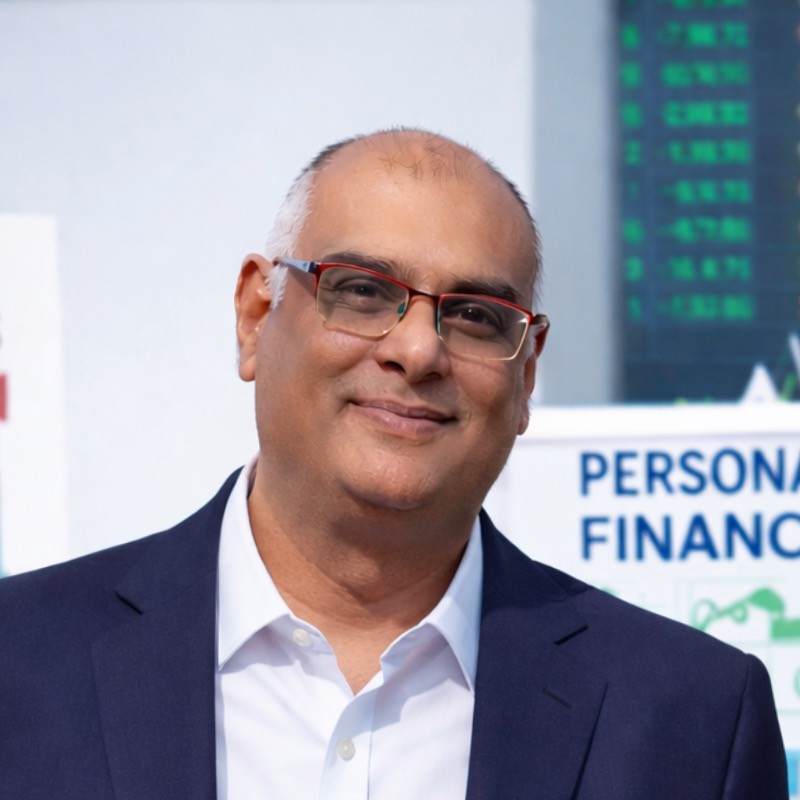
Dr. Ashu Handa
Chartered Accountant, Law Graduate and PhD in Economics. Founder of BeSampann Financial Awareness — a financial literacy initiative for young India.
The Power of Starting Early
Two investors, the same monthly amount, the same rate of return. One starts at 25. The other starts at 35. The gap at 60 is not double. It is closer to 3.4×.
Saving Is Not Investing
They sound similar, they use the same money, and they solve completely different problems. Confusing the two is one of the most expensive mistakes young Indians make.